
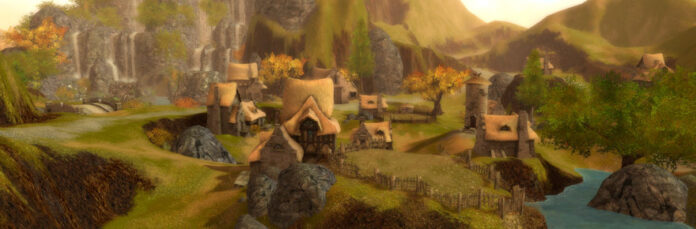
When I started brainstorming my column for this week, the first thing I started thinking about was talking about the terrible yet wonderful story of the original Guild Wars: Prophecies. That game has some marvelously janky story, it’s not good by any objective measure, and yet to this day I can make MOP’s Bree and myself laugh by bringing up Prince Rurik getting angry that someone is trifling with doors. It is the best and I love it so much.
But from there I started thinking about how the game wasn’t really alone in the fact that it was trying to do something with telling stories. Oh, sure, I was coming to it from Final Fantasy XI, which definitely wanted to tell a story… but that wasn’t unique, either. Like, there’s an idea that story in World of Warcraft is a new thing that wasn’t in the game at some point, and that’s just objectively not true. Stories and MMOs have been here all the way since Ultima Online… even though their presentation, intent, and design have changed a lot and still haven’t fully nailed the idea.
Now, you might be saying that UO at launch did not have the equivalent of a main story questline running through the game. But that’s not really the point. UO had a story investment from the start because the game is called Ultima Online. In my estimation, the Ultima franchise has never been great at world-building, but having a narrative running through the games is a major part of the franchise all the way through. Ultima IV was a major stride forward as a game that was trying to tell a story about virtues and noble behavior, a complete departure from the idea of RPGs as fantasy murder simulators. The idea that each game in this franchise was about an adventure was the buy-in for a game being called Ultima in the first place.
It’s not alone, either. You can talk about a dearth of main story in Star Wars Galaxies but it’s not like the game is set in some wholly conjured universe. Not only does it occur in a well-known universe but at a specific time in that universe. There is story implied! Loads of it, in fact! And the focus was frequently on the idea of having lots of little stories in the tapestry of a larger narrative that was happening with forces you didn’t interact with directly.

This is almost transparently true when it comes to WoW, which had tons of story to inherit from the at-the-time fairly fresh Warcraft III. And it was telling those stories. Lots of those stories weren’t really developed in much depth or told with much deftness, but we were clearly supposed to take stories away from them. Moira Bronzebeard marrying into the Dark Irons, Fandral Staghelm poisoning Malfurion to keep him asleep, Sylvanas plotting in her necrotic kingdom, Thrall trying to group hug the clearly inisidious Horde forces he hadn’t excised… there was a ton of story. And that’s not even counting things like the Uldaman questline that hinted at something new or the individual zone-wide vignettes scattered hither and yon.
Seriously, the amount of implication that Karazhan is something entirely different from what it ended up being is shot through Duskwood from start to finish, and if you play the classic zone, it feels like the lead-in to a later zone that, sadly, doesn’t exist.
My point here is not “if you look closely, there is a main story that you have to get through,” but that it’s not as if Guild Wars had an idea that had never been touched upon beforehand. Indeed, finding the right way to have a narrative line that runs through the game while also letting you go off and have your own adventures has been a consistent challenge for… well, basically the whole time. FFXI and GW were both experimenting with it, and they were hardly alone in that department.
At the same time, it is fair to say that there is a textural shift, and in large part, it’s an understandable one. GW’s story provides a good point of reference here. The story is trying to be about a sequence of events in which you uncover various powers manipulating Tyrian politics and kill them, which means that the people you need to hobnob with are usually pretty important. That means the story needs to make you someone notably important within the game world, which means you get an Ascalonian social upgrade at the end of the pre-searing events and then subsequently wind up being forced into the role of leadership.
On the bright side, this gives you a constant narrative momentum to move forward. On the down side, it means that your character is now locked into being a specific sort of person and more of a character in an otherwise fixed story. You are a character, not an observer, and that allows you to be acted upon and given motivation more directly.

To a degree, this isn’t even unique to MMOs. Early video games had stories. Those stories were typically not complex ones, but there is a narrative in Donkey Kong. As time has gone by, both the creative people making these games and the players who enjoy them have wanted these stories to do more, and over time developers have found ways to provide more story… often basically hijacking the functional elements of moviemaking because that’s the system that works best. There’s always a lot of narrative push and pull to find the best way to tell the story.
You can whine about cutscenes if you want to, but they’re generally the best option for telling a story. And let’s not forget that we’ve gotten cinematic perfection from them.
MMOs have a unique problem in terms of storytelling because they have a certain set of limitations for consequences or big changes. In Final Fantasy XIV: Endwalker, the loporrit section is interminable because we know the expansion can’t end with the world destroyed, so faffing about pretending that it might happen feels pointless. But that unique problem does not mean that stories are somehow a new addition.
Really, the biggest change is that we have begun an era in which story execution has become a bigger priority, especially for larger MMOs. I think there’s a lot to talk about there, as well, things that work and don’t work and that will hopefully get better with time… but the story itself is familiar territory. We weren’t first experiencing stories when the original Guild Wars rolled out.
And oh, my goodness, is that story still beautiful in all of its flaws. I will never stop loving it. Like, I will point to many better stories that postdate it as better actual tales, but part of me cannot help but love Prince Rurik in a “holy Moses does this dude stink” sort of way. What a dingus. I love him.
 Sometimes you know exactly what’s going on with the MMO genre, and sometimes all you have are Vague Patch Notes informing you that something, somewhere, has probably been changed. Senior Reporter Eliot Lefebvre enjoys analyzing these sorts of notes and also vague elements of the genre as a whole. The potency of this analysis may be adjusted under certain circumstances.